Understanding the legal status of zaleplon in Japan is essential for travelers, expatriates, patients, and healthcare professionals. Japan maintains one of the strictest pharmaceutical regulatory frameworks in the world, particularly for medications affecting the central nervous system. Drugs that are routine prescriptions in Europe or North America may be tightly restricted—or entirely unavailable—under Japanese law.
Zaleplon, a non-benzodiazepine hypnotic commonly prescribed for short-term insomnia in several countries, occupies a unique and often misunderstood position within Japan’s regulatory system. This article explains how zaleplon is classified, whether it is approved, how importation is treated, and what legal risks may arise for individuals.
What Is Zaleplon?
Zaleplon is a sedative-hypnotic medication belonging to the “Z-drug” class, which also includes zolpidem and zopiclone. It acts selectively on the GABA-A receptor complex, promoting sleep onset with a relatively short half-life. Because of its rapid clearance, zaleplon is often prescribed for sleep-onset insomnia rather than sleep maintenance.
Internationally, zaleplon is marketed under brand names such as Sonata. However, international availability does not determine legality in Japan, where domestic approval is mandatory regardless of foreign regulatory status.
Japan’s Drug Regulatory Framework
Japan regulates pharmaceuticals through a combination of national statutes and administrative oversight.
Key Governing Authorities
- Ministry of Health, Labour and Welfare (MHLW)
- Pharmaceuticals and Medical Devices Agency (PMDA)
All prescription drugs must be approved under the Pharmaceuticals and Medical Devices Act (PMD Act) before they can be manufactured, imported, or prescribed.
Authoritative reference:
PMDA – Pharmaceutical Approval System
https://www.pmda.go.jp/english/review-services/reviews/0001.html
Is Zaleplon Approved in Japan?
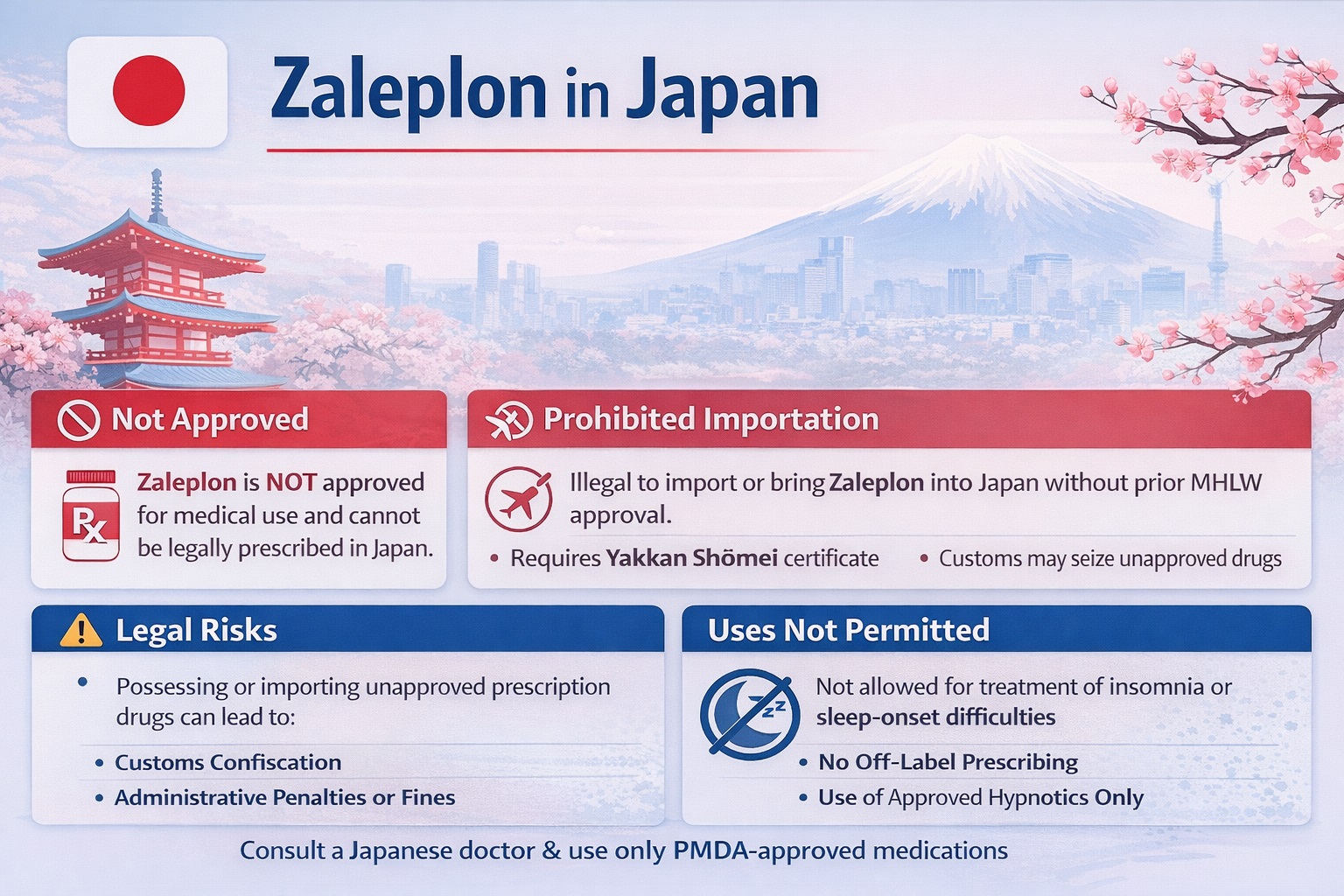
Zaleplon is not approved for medical use in Japan.
As of the latest PMDA drug database review, zaleplon:
- Is not listed in the Japanese drug approval registry
- Has no approved brand name or generic equivalent
- Is not prescribed in Japanese hospitals or clinics
Because it lacks approval under the PMD Act, zaleplon cannot be legally marketed, dispensed, or routinely prescribed in Japan.
This alone places zaleplon in a fundamentally different category than approved hypnotics.
Is Zaleplon a Controlled or Banned Substance in Japan?
Zaleplon is not listed under Japan’s:
- Narcotics and Psychotropics Control Act
- Stimulants Control Act
However, absence from controlled-drug schedules does not mean legality. Under Japanese law, unapproved pharmaceuticals are still tightly regulated.
In practice, zaleplon is treated as an unapproved prescription drug, meaning possession and importation are restricted unless specific legal exemptions apply.
Legal authority:
MHLW – Narcotics and Psychotropics Control Act (English summary)
https://www.mhlw.go.jp/english/policy/health-medical/pharmaceuticals/01.html
Personal Importation of Zaleplon into Japan
The Personal Importation Rule
Japan allows limited personal importation of certain medications under strict conditions. However, unapproved prescription drugs like zaleplon fall into a high-risk category.
To legally bring zaleplon into Japan, an individual would generally need:
- A valid medical prescription
- Prior approval via a Yakkan Shōmei (薬監証明) import certificate
- Quantities limited to personal therapeutic use (typically ≤ one month)
Without this certificate, zaleplon may be confiscated by Japanese customs.
Authoritative source:
MHLW – Importing Medicines for Personal Use
https://www.mhlw.go.jp/english/policy/health-medical/pharmaceuticals/01.html
Legal Risks of Importing or Possessing Zaleplon in Japan
Travelers frequently assume that medications legal elsewhere are permissible in Japan. This assumption can lead to serious legal consequences.
Potential outcomes include:
- Customs seizure of zaleplon at the port of entry
- Administrative penalties
- In rare cases, questioning or investigation
While zaleplon is not treated as a narcotic, Japanese authorities strictly enforce the PMD Act against unauthorized pharmaceuticals.
In real-world enforcement, customs officials have seized unapproved sleep medications even when travelers possessed foreign prescriptions.
Comparison With Other Sleep Medications in Japan
To better understand zaleplon’s status, it helps to compare it with other hypnotics.
Approved vs Unapproved Hypnotics
| Medication | Approval Status in Japan |
|---|---|
| Zaleplon | ❌ Not approved |
| Zolpidem | ✅ Approved |
| Zopiclone | ❌ Not approved |
| Benzodiazepines (e.g., triazolam) | ✅ Approved |
For example, Zopiclone (Japan) is also not approved, despite being commonly prescribed in Europe. This reflects Japan’s conservative approach to sedative-hypnotics.
How Zaleplon Differs From Other Restricted Drugs in Japan
Japan distinguishes between:
- Unapproved medicines (e.g., zaleplon)
- Explicitly prohibited stimulants or narcotics
For instance:
- Adderall (Japan) is prohibited due to amphetamine content
- Vyvanse (Japan) is approved only under strict psychiatric indications
- Modafinil (Japan) is prescription-only and tightly regulated
Zaleplon sits in a gray legal zone: not criminalized as a narcotic, but still illegal to sell or freely import.
Can Doctors Prescribe Zaleplon in Japan?
No. Japanese physicians cannot prescribe zaleplon, even off-label.
Under the PMD Act:
- Only PMDA-approved medications may be prescribed
- Off-label prescribing applies only to approved drugs
This differs from some Western jurisdictions, where doctors may prescribe non-approved uses of approved drugs.
Why Japan Has Not Approved Zaleplon
Several factors contribute to Japan’s regulatory stance:
- Preference for older benzodiazepines with long safety records
- Conservative pharmacovigilance standards
- Concerns over dependency, parasomnias, and misuse associated with Z-drugs
Japan’s cautious approach mirrors its stance on other psychoactive medications, such as Bupropion (Japan), which is also unavailable despite widespread global use.
Practical Guidance for Travelers and Residents
If you are traveling to or living in Japan:
- Do not assume zaleplon is legal
- Do not import it without prior approval
- Consult Japanese regulations before travel
- Consider approved alternatives prescribed by a Japanese physician
Japanese embassies consistently warn travelers that ignorance of drug law is not a defense.
Frequently Asked Questions
Is zaleplon illegal in Japan?
It is not approved and cannot be legally sold or prescribed. Importation without permission is illegal.
Can zaleplon be seized at Japanese customs?
Yes. Unapproved prescription drugs are commonly confiscated.
Is zaleplon treated as a narcotic?
No, but it is still regulated under the PMD Act.
Are there legal alternatives?
Yes, but only drugs approved by PMDA may be prescribed.
Conclusion
The legal status of zaleplon in Japan is clear from a regulatory standpoint: it is unapproved, non-prescribable, and restricted for importation. While it is not classified as a narcotic or stimulant, Japanese law does not permit casual possession or use.
For anyone dealing with sleep disorders in Japan, the safest and only legal route is to consult a licensed Japanese physician and use PMDA-approved medications exclusively.
Authoritative External Sources
- Pharmaceuticals and Medical Devices Agency (PMDA) – Drug Approval Framework
https://www.pmda.go.jp/english/review-services/reviews/0001.html - Ministry of Health, Labour and Welfare (MHLW) – Importing Medicines for Personal Use
https://www.mhlw.go.jp/english/policy/health-medical/pharmaceuticals/01.html