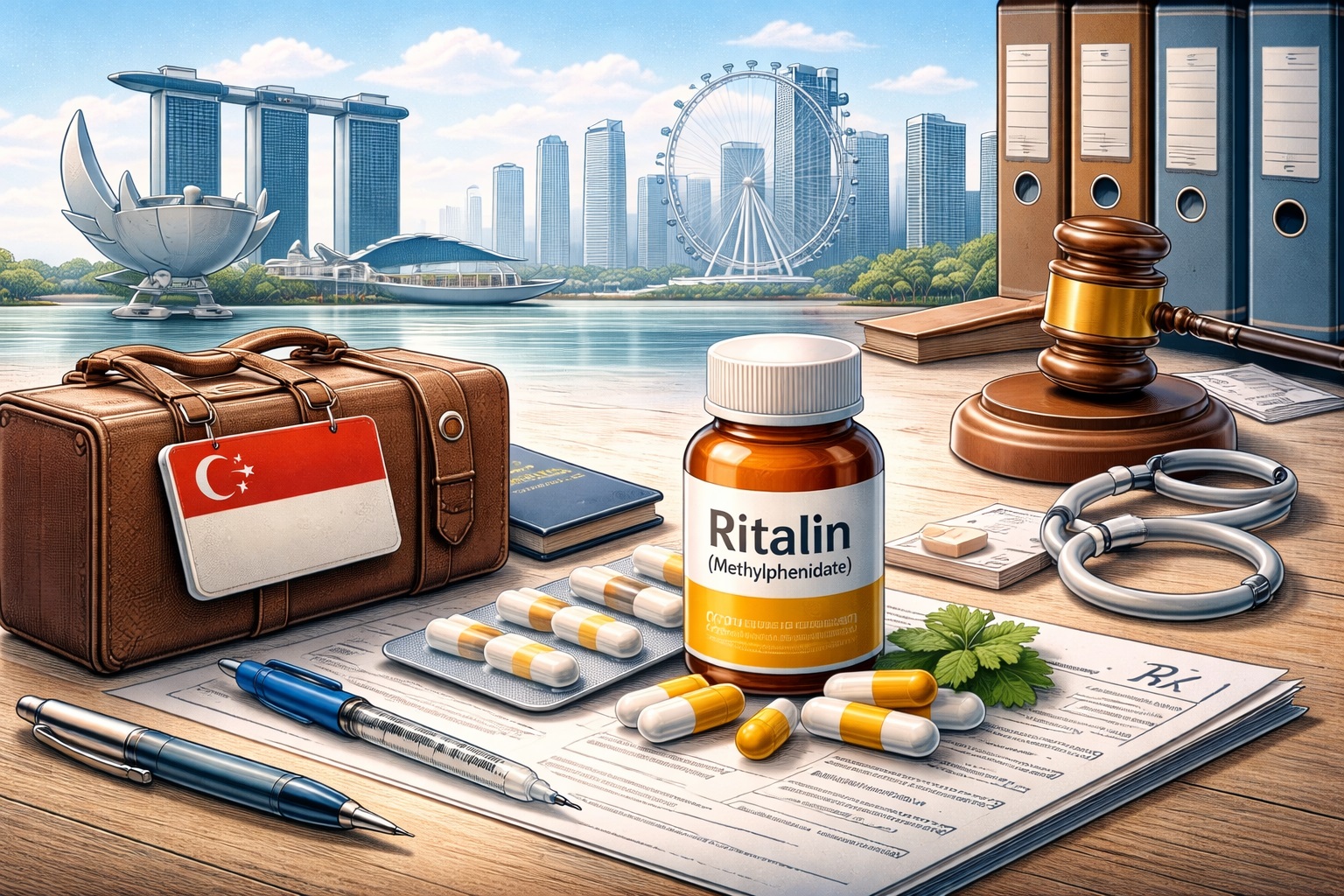
Introduction
Ritalin is one of the most widely prescribed medications for attention deficit hyperactivity disorder (ADHD) worldwide. However, its legal status varies significantly by country, and Singapore is known for having some of the strictest drug laws globally. For residents, expatriates, and travelers alike, misunderstanding these rules can carry serious legal consequences.
This article provides a clear, legally accurate explanation of the legal status of Ritalin in Singapore, including how it is classified, who may lawfully possess it, and what penalties apply for unauthorized use or importation.
What Is Ritalin?
Ritalin is a brand name for methylphenidate, a central nervous system stimulant commonly prescribed for ADHD and narcolepsy. Pharmacologically, it increases dopamine and norepinephrine activity in the brain, improving attention and impulse control.
Because of its stimulant properties and potential for misuse, methylphenidate is tightly regulated across most jurisdictions. Its legal treatment often aligns more closely with amphetamine-based medications than with non-stimulant ADHD treatments.
How Singapore Classifies Ritalin
In Singapore, Ritalin is classified as a controlled drug under the Misuse of Drugs Act (MDA). Methylphenidate is listed in the Second Schedule of the Act, placing it in a high-control category due to its abuse potential.
The governing authority responsible for enforcement and oversight is the Central Narcotics Bureau (CNB), operating under the Ministry of Home Affairs. Medical approval and prescribing oversight fall under the Health Sciences Authority (HSA).
Under Singapore law, controlled drugs may only be possessed or used under very specific medical circumstances.
Is Ritalin Legal in Singapore?
Yes — but only with strict medical authorization.
Ritalin is legal in Singapore only when:
- Prescribed by a Singapore-registered medical practitioner
- Dispensed by a licensed pharmacy or hospital
- Used strictly in accordance with the prescription
Any possession outside these conditions is illegal, even if the medication was lawfully obtained overseas.
This approach is consistent with Singapore’s broader treatment of stimulant medications, which also affects substances such as Adderall in Singapore.
Prescription Requirements in Singapore
To legally obtain Ritalin in Singapore, a patient must:
- Be formally diagnosed with ADHD or another recognized medical indication
- Consult a licensed Singapore physician, typically a psychiatrist
- Receive a local prescription compliant with HSA regulations
Foreign prescriptions are not automatically recognized. Even long-term users prescribed Ritalin abroad must undergo reassessment by a Singapore doctor.
Bringing Ritalin Into Singapore
Travelers frequently encounter legal trouble due to misunderstanding import rules.
Personal Importation Rules
Under HSA guidelines, travelers may bring controlled medications into Singapore only if:
- The medication is for personal use
- Quantity does not exceed three months’ supply
- An original prescription or doctor’s letter is carried
- Prior approval is obtained when required
Failure to meet any of these conditions can result in seizure and investigation.
Real-world enforcement cases show that customs authorities do not treat ignorance as a defense. Even small quantities can trigger legal action.
Penalties for Illegal Possession or Import
Singapore enforces some of the harshest drug penalties in the world.
Under the Misuse of Drugs Act, illegal possession of methylphenidate may result in:
- Fines
- Imprisonment
- Criminal record
- Drug rehabilitation orders
Trafficking or large-quantity possession carries significantly heavier penalties, even if the substance is prescription-only in other countries.
Comparison With Other ADHD Medications
Singapore’s regulatory framework treats stimulant medications far more strictly than non-stimulant alternatives.
For example:
- Atomoxetine (a non-stimulant ADHD drug) is regulated differently in some jurisdictions.
- Wake-promoting agents like modafinil are subject to distinct legal frameworks internationally.
These comparisons highlight why patients relocating to Singapore are often switched to alternative therapies.
Readers seeking broader context on regulated medications may also explore:
International Regulatory Context
Globally, methylphenidate is recognized as a substance with abuse potential.
The World Health Organization (WHO) includes methylphenidate in its essential medicines discussions while acknowledging dependency risks.
In Singapore, domestic law overrides international prescribing norms. This is similar to how national authorities diverge from international standards in other jurisdictions.
For comparison:
- The U.S. FDA Controlled Substance Schedules classify methylphenidate as Schedule II
- Singapore’s classification is stricter in terms of importation and enforcement
Medical and Legal Risks for Expats
Expats are disproportionately affected by Ritalin enforcement due to assumptions based on home-country legality. Legal advisors in Singapore frequently report cases involving:
- Students arriving with undeclared medication
- Professionals importing refills by mail
- Tourists carrying leftover prescriptions
In nearly all cases, penalties are applied regardless of medical intent.
Practical Guidance
If you live in or plan to travel to Singapore:
- Do not bring Ritalin without confirming HSA requirements
- Never ship Ritalin by international mail
- Seek local medical consultation before arrival if possible
- Keep documentation accessible at all times
For broader legal medication research, LegalStatusOf.com also maintains jurisdictional guides and vendor-related legal analysis in its vendors category.
Conclusion
Ritalin is not illegal outright in Singapore, but it is among the most tightly regulated prescription medications in the country. Legal possession depends entirely on local medical authorization and strict compliance with import and use rules.
What is routine ADHD treatment in many countries can quickly become a criminal offense in Singapore if handled incorrectly. Understanding the law before traveling or relocating is essential.
Legal Disclaimer
This article is for informational purposes only and does not constitute legal advice. Drug laws and enforcement practices may change. Always consult official government sources or a qualified legal professional for case-specific guidance.
External Authoritative Sources
- Singapore Misuse of Drugs Act – Statutes Online
https://sso.agc.gov.sg/Act/MDA1973 - Health Sciences Authority (HSA): Bringing Medications Into Singapore
https://www.hsa.gov.sg/personal-medication - World Health Organization – Drug Scheduling Reports
https://www.who.int/publications