Introduction
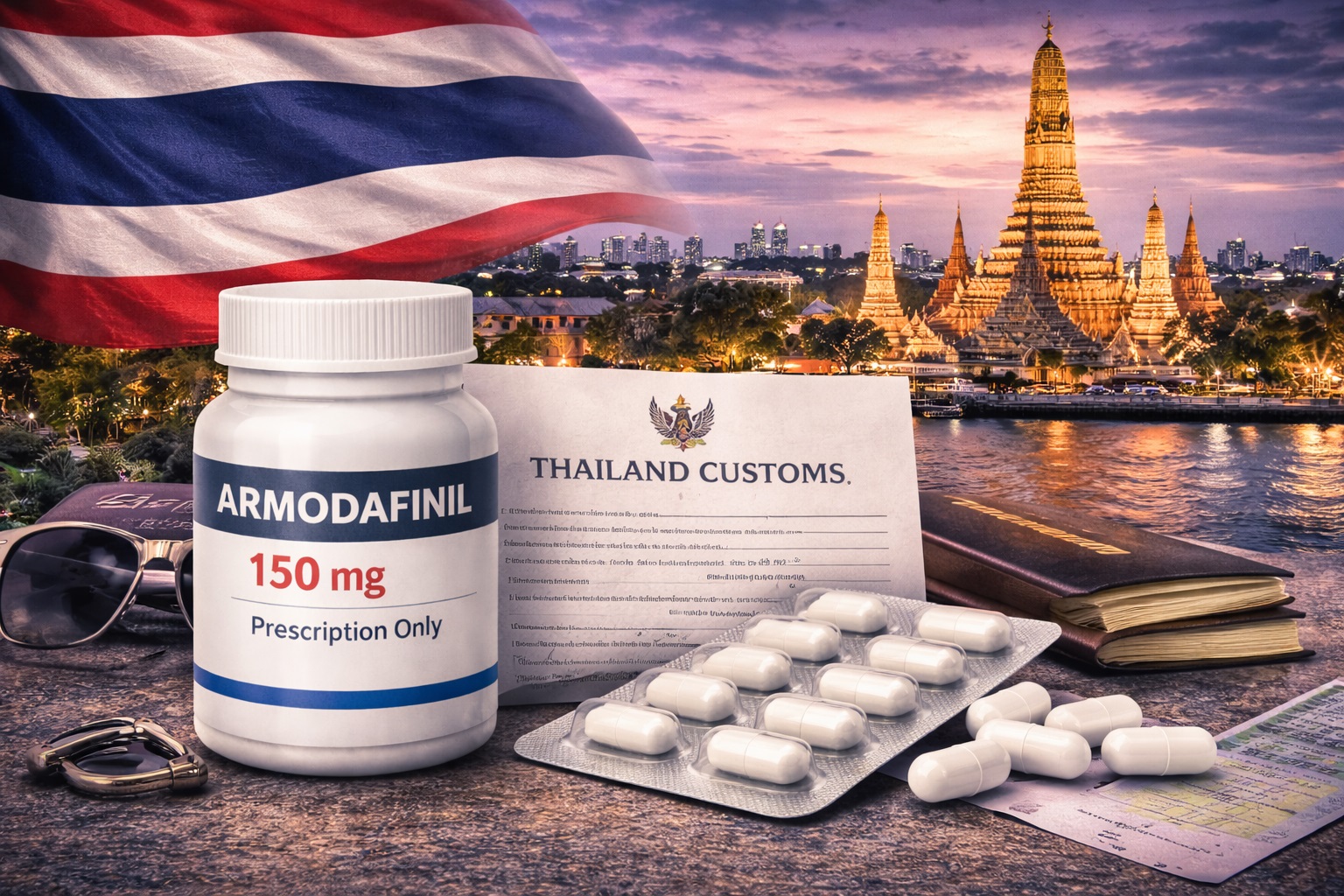
Armodafinil is a wakefulness-promoting medication prescribed in several countries for conditions such as narcolepsy and shift work sleep disorder. Despite its regulated medical use elsewhere, Thailand applies a highly restrictive approach to pharmaceuticals that are not formally approved for domestic use.
For travelers, expatriates, clinicians, and policy analysts, understanding the legal status of armodafinil in Thailand is essential. This article provides a clear, law-based overview of how armodafinil is classified, why it is prohibited, and what legal risks apply under Thai drug and customs law.
What Is Armodafinil?
Armodafinil is the R-enantiomer of modafinil and is designed to provide longer-lasting wakefulness-promoting effects. It is commonly marketed internationally under brand names such as Nuvigil and is typically regulated as a prescription-only medicine.
Although pharmacologically related to modafinil, armodafinil is treated as a separate substance for regulatory purposes in many jurisdictions.
Is Armodafinil Legal in Thailand?
Approval Status Under Thai Law
Armodafinil is not approved or registered for medical use by the Thai Food and Drug Administration (Thai FDA), which regulates pharmaceuticals under the Drug Act B.E. 2510 (1967).
Under Thai law, any modern medicine that is not registered with the Thai FDA is classified as an unauthorized drug. Possession, importation, or distribution of unauthorized drugs is prohibited regardless of whether the medication is legal or prescribed in another country.
Is Armodafinil a Narcotic or Controlled Substance?
Armodafinil is not listed by name under Thailand’s Narcotics Act or Psychotropic Substances Act. However, this distinction does not legalize it.
Thai pharmaceutical law separates substances into:
- Narcotics
- Psychotropic substances
- Unregistered modern medicines
Armodafinil falls into the third category, which still carries criminal liability for possession or importation..
Comparison With Modafinil in Thailand
Armodafinil is frequently compared to modafinil due to their pharmacological similarity. However, modafinil is also illegal in Thailand without Thai FDA approval.
For detailed jurisdiction-specific analysis, see Modafinil (Thailand). Thailand’s position contrasts sharply with countries where prescription access exists, such as Armodafinil (USA) and Armodafinil (Australia).
For broader regulatory context, readers may also consult Modafinil (Overview), which explains how wakefulness agents are treated across different legal systems.
International Regulatory Context
Armodafinil is not scheduled under international drug control conventions administered by the World Health Organization (WHO). WHO pharmacovigilance assessments nevertheless recognize its stimulant-like properties and potential for misuse.
International non-scheduling does not override national law. Thailand retains full authority to prohibit substances that are not approved domestically.
Clinical and Professional Implications
Thai-licensed physicians cannot prescribe armodafinil, as it is not an approved medicine. Prescribing or supplying unregistered drugs would violate professional standards enforced by Thai medical and regulatory authorities.
Foreign clinicians practicing temporarily in Thailand are also subject to Thai pharmaceutical law, regardless of licensing in other jurisdictions.
Practical Guidance for Travelers and Expats
- Do not bring armodafinil into Thailand
- Do not ship it by mail or courier
- Do not rely on foreign prescriptions
- Consult a Thai physician for legal alternatives
- Declare medications if uncertain
Non-compliance can result in criminal charges and long-term immigration consequences.
Key Takeaways
- It is not approved or registered with the Thai FDA
- Foreign prescriptions offer no legal protection
- Enforcement is consistent and strict
Legal Disclaimer
This article is provided for informational purposes only and does not constitute legal or medical advice. Drug laws in Thailand are strictly enforced and subject to change. Always consult Thai regulatory authorities or a qualified legal professional for case-specific guidance.