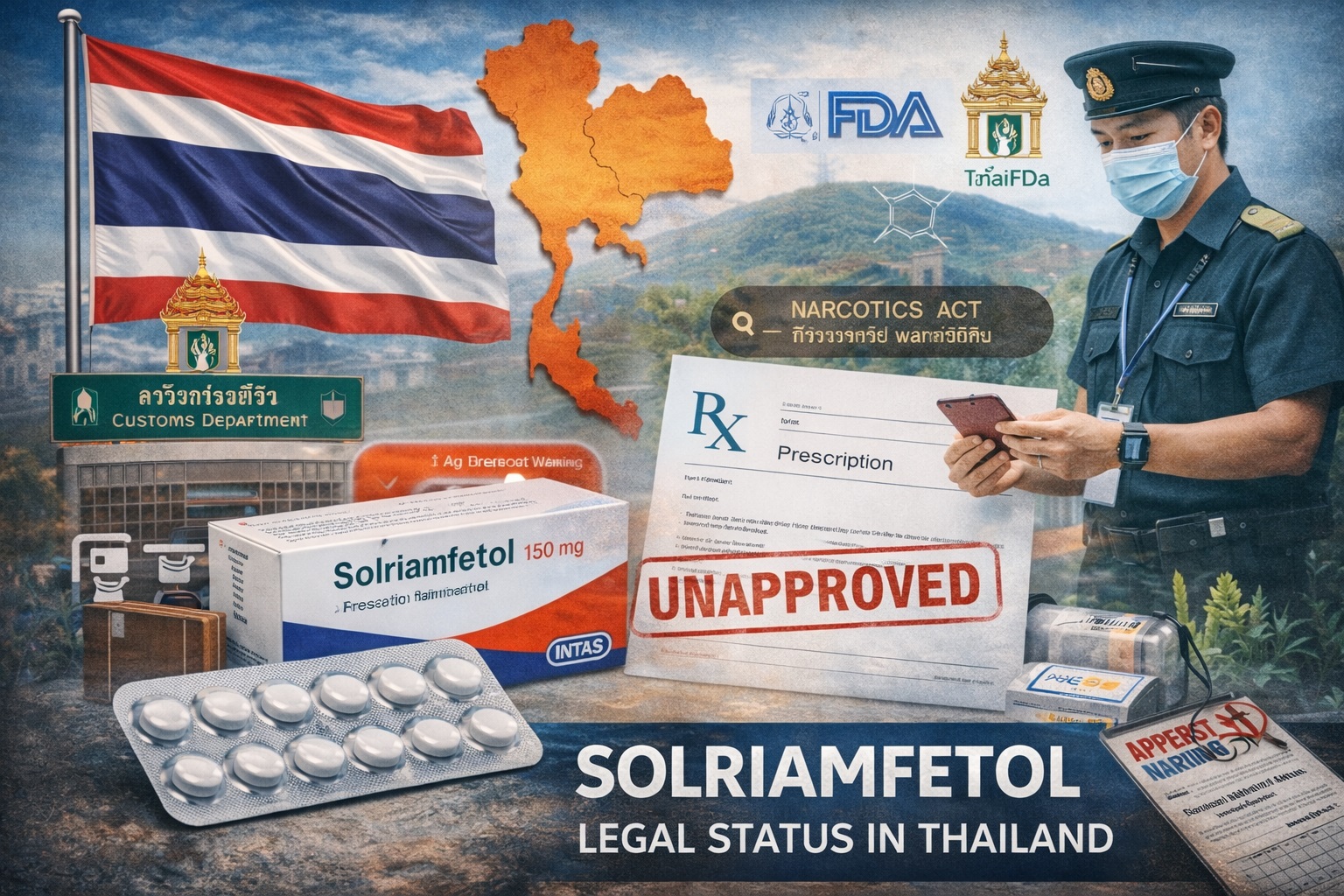
Solriamfetol is a relatively new wakefulness-promoting medication that has attracted attention among clinicians, travelers, and patients managing excessive daytime sleepiness. As international movement increases and prescriptions cross borders, questions often arise about whether a medication that is lawful in one country may be restricted in another. This article provides a clear, legally grounded analysis of the legal status of solriamfetol in Thailand, with a focus on prescription rules, import controls, and regulatory oversight.
The information below is written for travelers, healthcare professionals, policymakers, and general readers seeking accurate, up-to-date regulatory guidance rather than anecdotal advice.
What Is Solriamfetol?
Solriamfetol is a prescription medication approved in several jurisdictions for the treatment of excessive daytime sleepiness associated with narcolepsy and obstructive sleep apnea. Pharmacologically, it acts as a dopamine and norepinephrine reuptake inhibitor, distinguishing it from amphetamine-based stimulants.
In regulatory discussions, Solriamfetol in the USA and Solriamfetol in the UK, are available strictly under prescription control.
Thailand’s Drug Control Framework
Governing Authority
In Thailand, medicines are regulated by the Thai Food and Drug Administration (Thai FDA) under the Ministry of Public Health. The primary legal instrument governing medicines is the Drug Act B.E. 2510 (1967), along with subsequent amendments and ministerial notifications.
Under this framework, drugs are classified into categories such as:
- Specially Controlled Drugs
- Dangerous Drugs
- Household Remedies
- Traditional Medicines
Each category carries different requirements for prescribing, dispensing, and importation.
Is Solriamfetol Approved in Thailand?
As of the most recent regulatory disclosures, solriamfetol is not listed as an approved pharmaceutical product in Thailand. This means it does not appear in the Thai FDA’s publicly available database of registered modern medicines.
From a legal standpoint, lack of approval does not automatically imply illegality, but it does significantly restrict availability. Unapproved medicines generally cannot be sold, marketed, or routinely prescribed within Thailand.
This regulatory position contrasts with jurisdictions where solriamfetol has undergone formal evaluation, such as Australia and the United Kingdom, where prescription frameworks exist.
Prescription Status and Domestic Availability
Because solriamfetol is not registered with the Thai FDA, it is not legally available through Thai pharmacies, hospitals, or clinics as a standard prescription medicine. Thai physicians are therefore unable to prescribe it through conventional domestic channels.
In practice, this places solriamfetol in a regulatory position similar to other unregistered wakefulness agents
Personal Importation: What Travelers Should Know
Import Rules for Prescription Medicines
Thailand enforces strict import controls on medicines, even when they are prescribed legally in another country. According to guidance issued by the Thai Ministry of Public Health, travelers may import prescription medicines only for personal use, and typically only in limited quantities.
Key requirements usually include:
- A valid medical prescription
- Documentation identifying the prescribing physician
- Quantities consistent with personal therapeutic use
However, for unregistered medicines, customs officials retain broad discretion to detain, seize, or reject the product, even when documentation is provided.
Risk of Seizure at Customs
Real-world enforcement in Thailand demonstrates that customs authorities actively screen incoming pharmaceuticals. While solriamfetol is not classified as a narcotic or psychotropic substance under Thai law, its unregistered status increases the likelihood of scrutiny.
Cases involving other prescription-only cognitive or wakefulness agents show that:
- Medications may be confiscated without criminal charges
- Travelers may be questioned about medical necessity
- Lack of Thai FDA registration is often decisive
This enforcement approach mirrors Thailand’s handling of certain foreign prescriptions, similar to controls applied to stimulant-adjacent medications in other jurisdictions.
Controlled Substance Considerations
Importantly, solriamfetol is not listed under Thailand’s Narcotics Act and does not fall within the psychotropic schedules governed by the Psychotropic Substances Act B.E. 2518 (1975). This distinguishes it from substances that carry criminal penalties for possession.
However, absence from narcotics schedules does not guarantee lawful possession, as Thailand’s Drug Act independently restricts unapproved modern medicines.
International Regulatory Context
From a global perspective, solriamfetol has been evaluated by major regulatory agencies. The European Medicines Agency (EMA) has published assessment reports outlining its safety and efficacy profile, while post-marketing surveillance data are accessible through WHO pharmacovigilance frameworks, including the WHO Programme for International Drug Monitoring.
These international evaluations support medical legitimacy but do not override national drug laws, particularly in countries with centralized approval systems like Thailand.
Comparison With Other Wakefulness Agents
Travelers often assume regulatory equivalence between solriamfetol and other medications used for sleep-wake disorders. In reality, Thailand distinguishes sharply between substances.
For example:
- Modafinil has a documented enforcement history
- Some antidepressants and ADHD medications face outright bans
- Newer agents may fall into regulatory gray zones
Readers interested in comparative legality may also find broader context in overview resources such as Modafinil (Overview) or vendor-related compliance discussions available through https://www.legalstatusof.com/category/vendors/.
Practical Guidance for Travelers and Clinicians
For individuals considering travel to Thailand while using solriamfetol:
- Consult the Thai embassy or Ministry of Public Health before travel
- Carry original packaging and prescription documentation
- Expect possible questioning or confiscation at customs
- Consider discussing alternative, locally approved treatments with a physician
Clinicians advising patients should emphasize that foreign prescriptions do not guarantee cross-border legality.
Conclusion
In summary, solriamfetol is not an approved medication in Thailand, and its legal status is best described as unregistered and restricted. While it is not classified as a narcotic or psychotropic drug, possession and importation remain legally uncertain and subject to enforcement discretion.
For travelers and healthcare professionals alike, understanding Thailand’s conservative pharmaceutical approval system is essential to avoiding legal and logistical complications.
Legal Disclaimer
This article is provided for general informational purposes only and does not constitute legal or medical advice. Drug laws and enforcement practices may change without notice. Readers should consult official government sources or qualified legal professionals before importing or possessing prescription medications in Thailand.